 Quick Links
 Connect us

 Directors Databank (Empannel Yourself)
 Become a
  Become a
  Blog
Blog
 Become an Awards Assessor
 Publications
 Contact Us







The Highest Form of Resilience: Can Preparedness Foster Institutional Adaptability and Collective Responsibility?

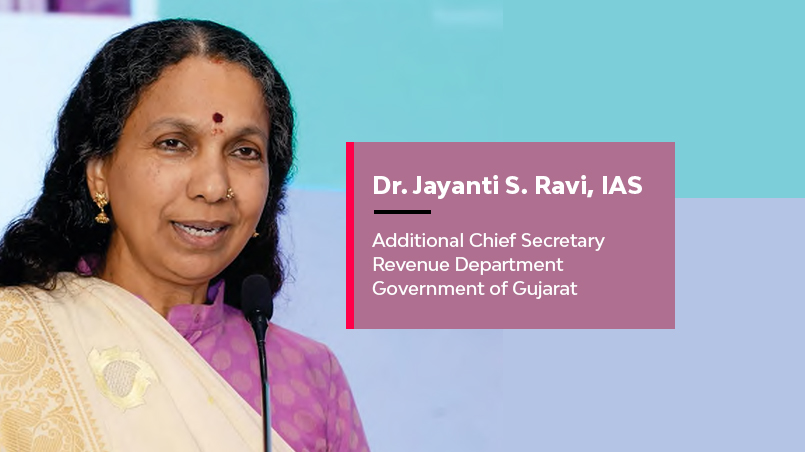
At the very outset, when I look across this gathering, I am reminded of a question that I believe all of us, at some point, reflect upon: What truly defines the hallmark of a civilisation?
Across time, cultures and geographies, there may be many answers. Yet, I believe one of the defining characteristics of any great civilisation is its 'Preparedness'. The hallmark of a resilient civilisation lies in how well it prepares itself for the future. In many ways, one could even say that compassion is the highest form of preparedness, because when we prepare, we prepare not only for ourselves but also for others who may be affected by unforeseen circumstances. Conversely, the absence of preparedness means that we continue to act without sufficient foresight for what the future may bring.
When we speak of climate risk, therefore, we are not merely referring to an environmental issue. Climate risk affects GDP, supply chains, agriculture, urban infrastructure, banking, public health, water security and, as we have witnessed in recent years, even pandemics. Whether it is urban flooding, COVID-19, earthquakes or other extreme events that are gradually becoming a part of our lived reality, one lesson stands out very clearly.
Resilience is not built during a disaster. Resilience is built by what we do before a disaster.
My grandfather often repeated a saying to us when we were children: "A small daily task, if done consistently every day, will surpass the labours of the sporadic Hercules.”
The message was simple. Extraordinary strength exercised occasionally can never match the power of consistency and preparedness.
If I may briefly reflect on Gujarat's journey, I would say that our history has been shaped by experiences that have repeatedly taken us out of our comfort zones and challenged us in unimaginable ways. Yet, under the visionary leadership of our Hon'ble Prime Minister, who was then the Chief Minister of Gujarat, combined with the remarkable spirit of enterprise that defines the people of this State, every challenge has strengthened our preparedness. If you scratch the surface of Gujarat, you will invariably find resilience, enterprise and an unwavering determination to rebuild. Each disaster has taught us valuable lessons and has strengthened our institutional capabilities.
Very recently, during Operation Sindoor, in my capacity as Additional Chief Secretary, Revenue, I spent several days in the State Control Room alongside our district administrations and municipal corporations. I witnessed first-hand the extraordinary coordination, preparedness and professionalism with which every team discharged its responsibilities. Experiences such as these reinforce an important truth. Preparedness today is not merely about responding to emergencies. It is about building resilience for every possible contingency.
Climate resilience, which today may be viewed as a competitive advantage, will very soon become an absolute necessity. A licence to operate.
Disaster planning and disaster management must adopt a truly multi-hazard approach, as the risks we face today are no longer confined to natural disasters alone.
That is why disaster planning and disaster management must adopt a truly multi-hazard approach, as the risks we face today are no longer confined to natural disasters alone. Alongside floods, cyclones and earthquakes, we must also prepare for industrial accidents, chemical disasters, cyber disruptions and emerging technological risks. As our dependence on digital technologies, artificial intelligence, APIs and interconnected systems continues to increase, our lives become more efficient and convenient. But at the same time, these very systems introduce new vulnerabilities. Preparedness must therefore evolve alongside technological advancement. Another important lesson is that disasters are never confined to a single sector. They create cascading impacts across multiple sectors simultaneously.
Recently, during the floods in Banaskantha district, particularly in the newly created district of Vav-Tharad, vast quantities of water accumulated in what had effectively become a saucer-shaped basin. Much of our Diwali was spent in continuous review meetings, trying to find ways to pump out the accumulated water.
But the flooding did not stop there.
Waterlogging disrupted electricity supply. Once electricity failed, mobile communications stopped functioning. Water pumps became inoperative, and one failure quickly triggered another. That experience reminded us just how deeply interconnected our systems truly are. The same interconnectedness exists across every sector industry, agriculture, education, finance, environment, water, power, transport, urban development and healthcare.
This brings me to another important principle. The strength of a chain is determined by its weakest link. Preparedness cannot mean excellence in a few areas while remaining vulnerable in others. Even if we achieve one hundred per cent preparedness in several sectors, a single weak link can cause the entire system to fail. Our objective, therefore, must be to build strong and consistent preparedness across every sector.
Preparedness is not limited to physical infrastructure. Buildings, roads and other infrastructure are undoubtedly important, but equally important is human capability. Training, capacity building, mock drills and continuous learning are what ultimately determine our response during crises. We must also engage with the younger generations, the Gen-Zs and Gen Alphas, not only to guide them but also to learn from them. Their awareness and sensitivity towards sustainability are often remarkable.
Preparedness must also be inclusive. No one should be left behind during disasters. Public-private partnerships therefore become indispensable. Technology too has emerged as one of the greatest enablers of modern disaster governance.
In Gujarat, we have established a state-of-the-art State Emergency Operations Centre near the Secretariat in Gandhinagar which integrates advanced forecasting systems, artificial intelligence, predictive analytics and real-time emergency management capabilities.
Yet even with such technological sophistication, we must continue strengthening our preparedness against every possible vulnerability. If there is one investment that yields the greatest return, it is investment in human capacity.
Technology and infrastructure are important, but ultimately it is people who make the difference.
There is another dimension that deserves equal attention. We must begin to recognise nature itself as critical infrastructure. When we restore wetlands, conserve mangroves, protect forests, strengthen watersheds, recharge groundwater and create urban green and blue-green spaces, we are not merely protecting nature, we are investing in climate-resilient infrastructure. It is heartening to see that in recent years there has been a growing sensitivity towards these issues.
Nature should never be viewed as a constraint on development. Nature is the very foundation of sustainable development. When we respect nature, we are ultimately safeguarding our own future.
The message for corporate Boards is equally clear.
Climate governance cannot remain confined to ESG reporting or regulatory compliance. Every Board must begin to think like a Risk Committee. And every Risk Committee must think about climate.
We must move beyond short-term optimisation towards long-term stewardship. An approach that focuses on sustaining, nurturing and strengthening our shared resources rather than merely extracting value from them.
As I conclude, I would emphasise that institutional adaptability is perhaps the defining requirement of leadership today.
At the beginning of my remarks, I spoke about preparedness. The true test of leadership is no longer only about how we respond during a crisis. It is about whether we possess the foresight to anticipate future challenges and prepare ourselves before they arise.
Because, ultimately, if we fail to prepare, we prepare to fail.
Thank you very much.
 Back to Home
Author
Dr. Jayanti S. Ravi, IAS
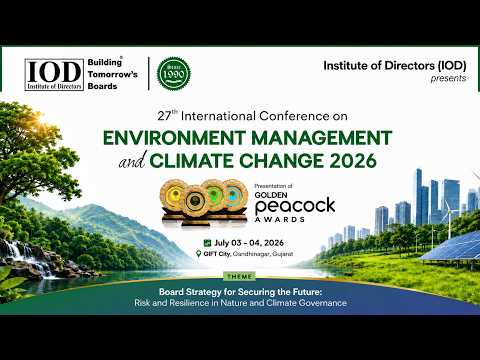
Additional Chief Secretary – Revenue Development, Govt. of Gujarat, during the Plenary Session–II of the 27th International Conference on Environment Management & Climate Change & Presentation of the Golden Peacock Awards, held on July 03, 2026 at the Radisson GIFT City Club, Gandhinagar, Gujarat.
Owned by: Institute of Directors, India
Disclaimer: The opinions expressed in the articles/ stories are the personal opinions of the author. IOD/ Editor is not responsible for the accuracy, completeness, suitability, or validity of any information in those articles. The information, facts or opinions expressed in the articles/ speeches do not reflect the views of IOD/ Editor and IOD/ Editor does not assume any responsibility or liability for the same.