 Quick Links
 Connect us

 Directors Databank (Empannel Yourself)
 Become a
  Become a
  Blog
Blog
 Become an Awards Assessor
 Publications
 Contact Us







The Power of "AND" in India's Energy Transition: Pursuing low-carbon innovation to strengthen energy security and sustainable growth

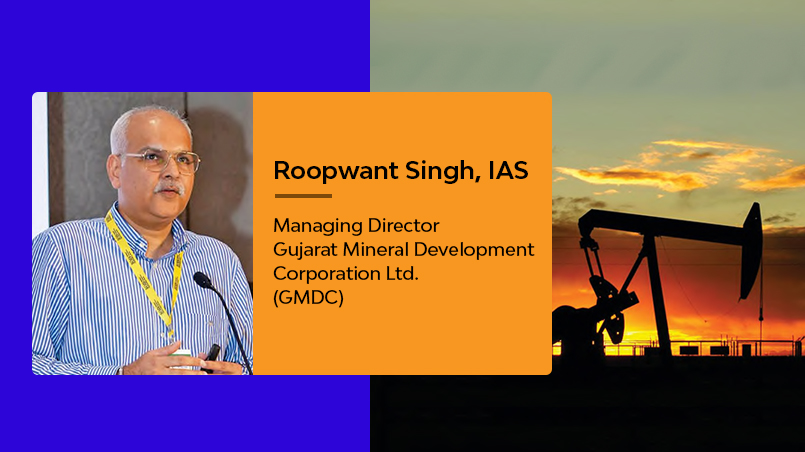
A couple of years ago, our Hon'ble Prime Minister, a global statesman, spoke about India's energy transition. Today, we are witnessing that vision gradually becoming a reality, with both state-owned enterprises and private industry working together to achieve this national ambition.
The subject I wish to discuss today is Underground Coal Gasification.
GMDC is a State-owned enterprise. We have traditionally been in the business of solid fuels, and going forward, we also intend to become a significant player in the critical minerals sector. Our core business today revolves around lignite and coal.
Let me begin by making one point very clear.
We are not talking about zero carbon. We are talking about low carbon.
We are not talking about zero emissions. We are talking about very low emissions. The global energy transition is a journey, and like every transition, it cannot be achieved through a single pathway. We will have to pursue multiple pathways simultaneously. Anything that enables us to significantly reduce carbon emissions deserves serious consideration. That is precisely why GMDC is investing in underground coal gasification.
India possesses nearly 450 billion tonnes of deep-seated coal reserves that cannot be economically or safely extracted through conventional mining. At the same time, our energy demand will continue to rise throughout this decade and well into the next. Our fuel import bill places an enormous burden on the country's economy.
What we are here to demonstrate is the power of "AND."
We can remain in the coal business and adopt environmentally sustainable and progressive technologies.
We can access resources that were previously considered inaccessible and simultaneously address critical national challenges.
Most of us are familiar with conventional coal mining and the environmental concerns associated with it. However, underground coal gasification offers a very different approach. Instead of mining the coal, we convert it underground into synthesis gas, extract its energy value, and significantly reduce carbon emissions by nearly 80% compared to conventional utilisation.
That is the power of "AND."
It is the power of pursuing multiple solutions rather than choosing between extremes.
Let me briefly speak about GMDC.
Out of India's vast coal reserves, GMDC alone possesses nearly three billion tonnes of coal resources. Of these, almost a quarter of a billion tonnes remain inaccessible using conventional mining techniques. Ironically, this inaccessible coal also happens to be among the highest-quality reserves.
GMDC is not alone in facing this challenge. Coal India subsidiaries and several private enterprises also possess similar deep-seated coal resources that remain beyond the reach of traditional mining methods. China has emerged as a global chemical superpower by extensively gasifying coal. However, much of its coal gasification is carried out on the surface. What we are proposing is fundamentally different.
With the world's second-largest coal reserves, India has an opportunity not merely to compete, but to surpass global benchmarks through underground coal gasification. This technology opens multiple value chains and numerous commercial pathways. of the nineteen identified opportunities, fourteen are already considered commercially credible, and today I have touched upon only a few of them.
The demand exists. The economics are attractive.
More importantly, we can solve a significant national challenge by utilising resources that were previously beyond our reach. Friends, this once again demonstrates the power of "AND."
For a rapidly growing country like India, we cannot afford to be absolutists. We must deploy every viable technology available to us. Green energy is undoubtedly our destination, and we will certainly get there. But every transition requires intermediate steps. The journey itself is important.
With the world's second-largest coal reserves, India has an opportunity not merely to compete, but to surpass global benchmarks through underground coal gasification.
Allow me, if you will, a brief marketing remark in the presence of so many distinguished corporate leaders.
Our role will primarily be in producing synthesis gas at the upstream stage. Thereafter, we intend to partner with downstream industries that can convert this synthesis gas into higher-value products. In other words, GMDC will focus on the upstream segment, while specialised downstream partners will create the final products. The opportunities that emerge from this model are significant.
Take ammonia, for example.
If ammonia is produced through this process, its cost is estimated to be only about 25% of the cost of imported ammonia. That extraordinary cost advantage creates immense commercial opportunities while simultaneously strengthening India's energy security.
Most importantly, it enables us to unlock energy without mining coal. I believe that is the real promise of this technology and the true power of pursuing multiple pathways in India's journey towards a sustainable energy future.
Thank you.
 Back to Home
Author
Roopwant Singh, IAS
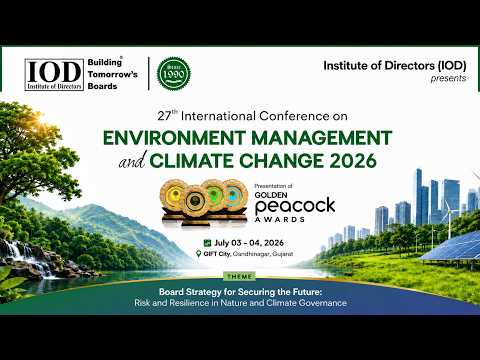
Managing Director, Gujarat Mineral Development Corporation Ltd. (GMDC), during the Plenary Session III of the 27th International Conference on Environment Management & Climate Change & Presentation of the Golden Peacock Awards, held on July 03, 2026 at the Radisson GIFT City Club, Gandhinagar, Gujarat.
Owned by: Institute of Directors, India
Disclaimer: The opinions expressed in the articles/ stories are the personal opinions of the author. IOD/ Editor is not responsible for the accuracy, completeness, suitability, or validity of any information in those articles. The information, facts or opinions expressed in the articles/ speeches do not reflect the views of IOD/ Editor and IOD/ Editor does not assume any responsibility or liability for the same.